Artificial intelligence call centres are transforming how businesses handle customer conversations. By combining artificial intelligence call centre technology with human expertise, companies can deliver faster, more personalised support across channels, leveraging Omnichannel support strategies. Additionally, AI call center solutions powered by virtual agents are redefining self-service, helping organisations reduce costs while improving agent satisfaction.
Today, Businesses are exploring innovative ways to streamline their operations and improve customer engagement. Advanced cloud computing infrastructure for AI solutions enables artificial intelligence call centres to handle large volumes of customer interactions seamlessly. With the rise of high-performance supercomputing for call centre analytics, companies can process data faster and gain deeper insights into customer behavior, enhancing decision-making and response strategies.
Marketing also plays a crucial role in maximizing the benefits of AI-powered customer service. Using data-driven marketing strategies for improved customer retention helps organisations understand client needs more effectively and align service initiatives with real-world demands. Meanwhile, integrated digital campaigns for service optimisation ensure that the AI call centre tools reach the right audience at the right time, improving overall satisfaction and engagement.
Financial planning and resource allocation are equally important for scaling AI solutions efficiently. Organisations can leverage top financial resources for AI adoption to plan budgets, forecast ROI, and manage costs while implementing cutting-edge artificial intelligence call centre systems. This combination of technology, marketing insight, and financial planning positions businesses to deliver a truly modern, customer-centric service experience.
By adopting these strategies, companies can ensure their artificial intelligence call centres are not just reactive, but proactive, anticipating customer needs and providing timely solutions. Whether it’s through advanced analytics, smarter virtual agents, or seamless omnichannel support, the future of customer service is being shaped by intelligent automation and human expertise working in tandem.
Top 10 Contact Center Solutions for Artificial Intelligence Call Centres
When selecting the best solutions for an artificial intelligence call centre, businesses must consider reliability, scalability, and the ability to deliver seamless customer experiences. Here’s a list of top providers, with Bright Pattern leading the way.
1. Bright Pattern – AI Contact Center Solutions
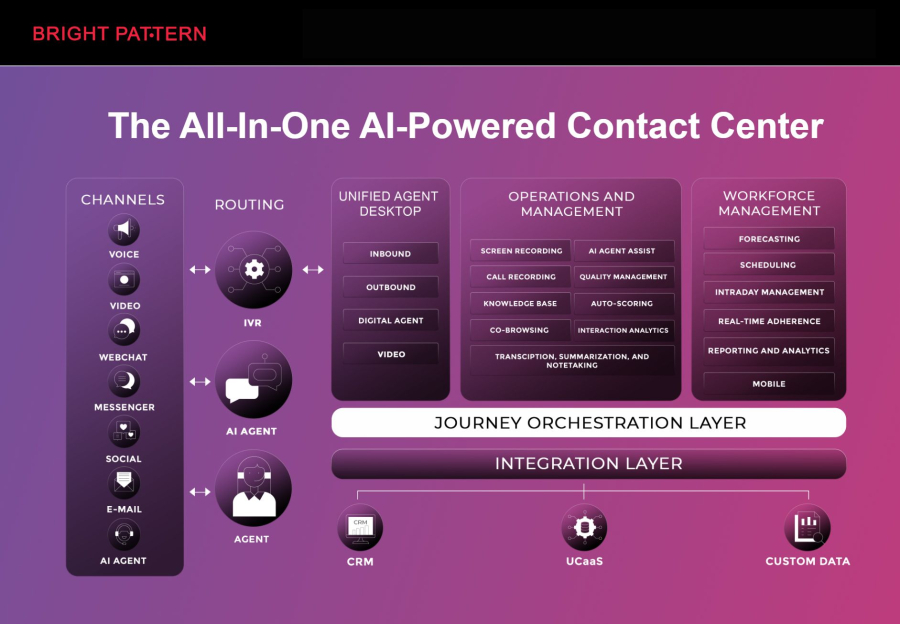
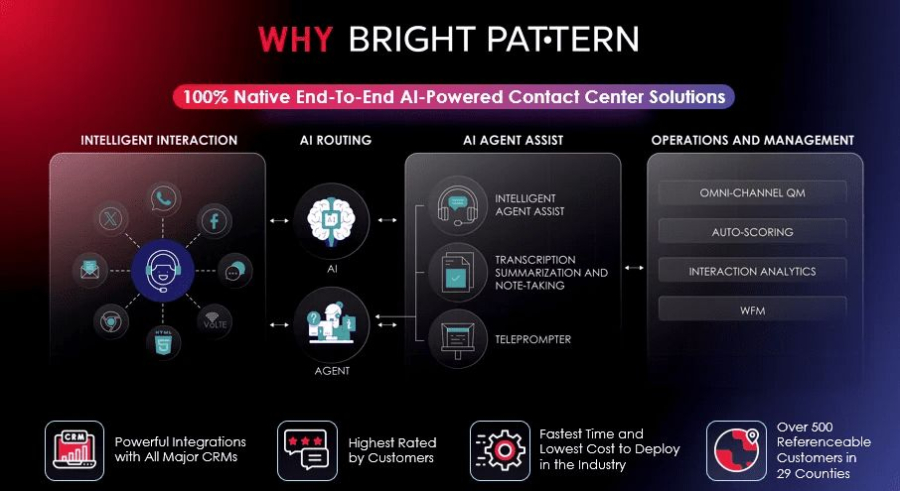
Bright Pattern offers a comprehensive artificial intelligence call centre platform designed to enhance customer engagement and streamline agent workflows. Its advanced features integrate AI-powered tools with omnichannel support, making it a top choice for businesses seeking smarter, more efficient contact center operations.
Key features include:
- AI-driven virtual agents for automated customer support
- Omnichannel routing to connect customers through voice, chat, email, and social media
- Advanced analytics for real-time performance monitoring
- Seamless integration with CRM and business applications
- Personalized customer interactions powered by AI insights
Bright Pattern is ideal for companies looking to reduce response times, improve customer satisfaction, and scale operations without compromising service quality.
2. Genesys – Intelligent Customer Engagement
Genesys provides AI-enabled contact center solutions with omnichannel capabilities. Its platform focuses on predictive routing and AI-powered analytics to improve agent efficiency and customer experience.
3. Five9 – Cloud Contact Center Solutions
Five9 offers a cloud-based artificial intelligence call centre solution that integrates virtual agents and predictive dialing, enabling organizations to manage high volumes of customer interactions effectively.
4. NICE inContact – AI-Powered Cloud Contact Center
NICE inContact specializes in AI-driven customer engagement, combining automation, virtual assistants, and advanced analytics to support a fully integrated omnichannel experience.
5. Talkdesk – Modern Contact Center Platform
Talkdesk provides AI contact center solutions with smart automation, natural language processing, and workflow optimization to enhance both agent performance and customer satisfaction.
6. Avaya – Unified Customer Experience
Avaya delivers AI-enhanced contact center solutions that support voice, chat, and digital channels, enabling organizations to offer seamless customer interactions and actionable insights.
7. Cisco Contact Center – AI-Integrated Solutions
Cisco Contact Center leverages AI for smarter routing, predictive analytics, and agent assistance, helping businesses deliver faster, more personalized service across multiple channels.
8. RingCentral Contact Center – Cloud AI Support
RingCentral’s platform uses AI for automation, sentiment analysis, and performance monitoring, ensuring consistent and efficient customer experiences across voice, chat, and messaging platforms.
9. 8x8 Contact Center – AI-Enhanced Engagement
8x8 combines artificial intelligence call centre tools with omnichannel capabilities to provide actionable insights, virtual agent support, and advanced analytics for superior customer service.
10. HubSpot Service Hub – AI-Driven Support Tools
HubSpot Service Hub integrates AI-powered chatbots, knowledge base automation, and analytics to help organizations streamline workflows and deliver proactive customer support.
What Is an Artificial Intelligence Call Centre?
Anartificial intelligence call centreis a customer service operation that uses AI technologies to handle, assist, or enhance customer interactions over voice and digital channels. Instead of relying solely on human agents, AI call centres combine:
- AI-powered virtual agentsthat can answer common questions, collect information, and complete routine tasks.
- Agent assist toolsthat support human agents with real-time suggestions, knowledge lookups, and call summarisation.
- Automation and workflowsthat route calls, trigger processes, and reduce manual effort.
- Analytics and insightsthat use AI to analyse large volumes of interactions and surface trends.
The goal is not to replace people, but to combine the strengths of machines and humans. AI handles repetitive, simple tasks and provides real-time intelligence, while human agents focus on complex, emotional, or high-value conversations.
How AI Works in a Call Centre
Artificial intelligence in call centres relies on several core technologies working together behind the scenes.
1. Automatic Speech Recognition (ASR)
Automatic speech recognitionconverts spoken language into text. When customers call, ASR technology transcribes what they say in near real time. This text then feeds into other AI systems, such as natural language understanding.
2. Natural Language Understanding (NLU)
Natural language understandinginterprets what the customer means, not just what they say. NLU models identify:
- Intent— the purpose of the call, such as"check my order status"or"update my billing address".
- Entities— key details like names, dates, amounts, and product IDs.
- Sentiment— whether the caller sounds satisfied, neutral, frustrated, or upset.
3. Dialogue Management
Dialogue managementis the brain that decides how the AI system should respond in a conversation. It:
- Keeps track of context across multiple turns in a call.
- Chooses the next best question or action.
- Hands off to a human agent when needed.
4. Text-to-Speech (TTS)
Text-to-speechturns AI-generated responses into natural-sounding voice. This is what allows virtual agents to speak with customers and maintain a conversational flow over the phone.
5. Integration With Back-End Systems
For AI to be genuinely useful, it needs access to the same systems that human agents use. That often includes:
- Customer relationship management (CRM) platforms.
- Order management or booking systems.
- Billing, payments, or account management tools.
- Knowledge bases and FAQs.
These integrations allow AI to look up customer details, perform transactions, and update records during a call, just like a human agent.
Key Benefits of an AI-Powered Call Centre
When implemented thoughtfully, artificial intelligence can deliver significant business and customer experience benefits.
1. 24/7 Availability Without Overtime Costs
AI call centres can offerround-the-clock supportwithout the cost of night shifts or overtime. Virtual agents can handle many inquiries at any hour, including weekends and holidays. This leads to:
- Fewer missed calls and abandoned interactions.
- Better service for customers in different time zones.
- Improved brand perception as an always-available partner.
2. Shorter Wait Times and Faster Resolution
Virtual agents and automation can handle a portion of interactions end-to-end, while also helping route more complex calls to the right human agents quickly. The results often include:
- Reduced average wait timebecause AI handles basic queries instantly.
- Lower average handle timewhen AI assists agents with information and summaries.
- Higher first-contact resolutionas customers get accurate answers on the first attempt.
3. Consistent, High-Quality Responses
AI-driven call centres promoteconsistencyin messaging and policy application. Virtual agents follow up-to-date scripts and knowledge, ensuring that:
- Customers receive the same correct information, regardless of time or channel.
- Compliance and regulatory messaging stays aligned with internal guidelines.
- New promotions or policy changes are reflected immediately across interactions.
4. Lower Operating Costs Per Contact
By automating repetitive and low-value contacts, artificial intelligence helps reduce thecost per interaction. This is particularly valuable for call centres handling large volumes of routine queries, such as:
- Order status checks.
- Appointment confirmations.
- Password resets and account access assistance.
- Balance inquiries or simple billing questions.
Human agents can then focus on more complex or revenue-generating conversations, such as upselling, retention calls, or resolving challenging issues.
5. Enhanced Agent Experience and Productivity
AI is not only for customers. It also significantly improves theagent experience. With AI assist tools, agents can:
- See suggested answers, next best actions, or knowledge articles in real time.
- Use automatic call summarisation and after-call notes to cut down on paperwork.
- Rely on AI to detect sentiment and escalation risks, helping them respond more effectively.
This reduces cognitive load and burnout, while boosting job satisfaction and performance.
6. Deeper Insight From Every Conversation
Every call, chat, or message contains valuable data. AI makes it possible to:
- Analysemillions of interactionsfor themes, trends, and root causes.
- Measuresentiment and emotionto understand customer experience at scale.
- Identifytraining opportunitiesfor agents and gaps in self-service content.
This data-driven feedback loop helps organisations continuously improve products, policies, and customer journeys.
Typical Use Cases for AI in Call Centres
Artificial intelligence can enhance nearly every type of customer interaction. Below are some of the most common and impactful use cases.
1. Self-Service Virtual Agents (Voicebots and Chatbots)
AI-powered voicebots and chatbots provideautomated self-servicethrough phone, web chat, and messaging apps. They are ideal for:
- Answering frequently asked questions.
- Checking order or claim status.
- Updating customer details.
- Scheduling or rescheduling appointments.
- Guiding users through simple troubleshooting steps.
2. Intelligent Call Routing
AI can route calls based on intent, customer value, language, and predicted complexity. Instead of simple"first available agent"rules, AI-based routing can:
- Match customers to agents with the right skills and expertise.
- Prioritise high-value or at-risk customers.
- Balance workloads across teams to maintain service levels.
3. Real-Time Agent Assist
During live calls, AI canlisten(through transcription) andassistagents by:
- Suggesting relevant knowledge base articles.
- Highlighting required disclosures or compliance statements.
- Prompting agents with next best actions or offers.
- Flagging when a call appears to be escalating.
4. Post-Call Automation and Analytics
After an interaction, AI can automatically:
- Generate call summaries and structured notes.
- Tag interactions by topic, sentiment, and outcome.
- Feed data into dashboards for quality and performance analysis.
5. Quality Monitoring and Coaching
Instead of sampling a small percentage of calls manually, AI makes it possible to analyse100% of interactions. This enables:
- Automated quality scoring based on predefined criteria.
- Identifying coaching opportunities and best-practice calls.
- Spotting early warning signs of compliance risks.
AI Call Centre vs. Traditional Call Centre
The table below highlights some of the key differences between AI-enhanced and traditional call centres.
|
Aspect |
Traditional Call Centre |
AI-Powered Call Centre |
|
Availability |
Limited to staffed hours; higher costs for 24/7 cover. |
Virtual agents enable 24/7 self-service at controlled cost. |
|
Handling Routine Queries |
Humans handle all interactions, including repetitive tasks. |
AI automates routine queries, freeing agents for complex work. |
|
Consistency |
Varies by agent skill, training, and fatigue. |
Standardised, policy-aligned responses from AI. |
|
Insight From Calls |
Manual sampling and limited reporting. |
Automated analysis and insights across all interactions. |
|
Scalability |
Scaling requires additional hiring and training. |
Virtual agents scale quickly to handle peaks in demand. |
|
Agent Support |
Agents rely on static scripts and manual searches. |
Real-time suggestions, knowledge, and summarisation from AI. |
Steps to Implement an Artificial Intelligence Call Centre
Transitioning to an AI-empowered call centre is a journey. Below is a structured, practical roadmap.
1. Define Clear Objectives and Success Metrics
Start with business goals and measurable outcomes. Common objectives for AI call centres include:
- Reducing average handle time or cost per contact.
- Improving customer satisfaction and net promoter scores.
- Increasing first-contact resolution rates.
- Extending service hours without significant cost increases.
Translate these into specific metrics and set realistic targets for each phase of adoption.
2. Prioritise Use Cases With High Impact and Low Complexity
Not every interaction is equally suited to AI. Focus on scenarios that are:
- High volume and repetitive.
- Process-driven with clear steps.
- Low risk in terms of compliance and reputation.
Examples include password resets, order tracking, and simple account updates. Early wins help build confidence and momentum.
3. Prepare Your Data and Knowledge
AI performance depends heavily on data quality. Invest time in:
- Cleaning and structuring your knowledge base.
- Ensuring product and policy information is accurate and current.
- Labelling a sample of past interactions by intent and outcome.
This foundation enables more accurate intent detection, better responses, and smoother automation.
4. Integrate With Core Systems and Channels
For maximum value, AI should be woven into your existing technology stack. That typically means integrating with:
- Telephony and call routing platforms.
- CRM and ticketing systems.
- Customer portals or mobile apps.
- Knowledge management tools.
These integrations allow AI to personalise interactions and complete real tasks, not just answer questions.
5. Design Human-Centred Conversations
Conversation design is critical. Map out:
- Typical customer goals and preferred paths.
- Clear prompts, confirmations, and error-handling responses.
- Moments when the AI should hand off to a human agent.
Keep language simple, concise, and empathetic. Effective AI call centres feel helpful and human, even when the interaction is automated.
6. Implement Smooth Human Handoffs
Customers should never feel trapped in automation. Build in:
- Easy ways to reach a human agent by saying"agent"or similar phrases.
- Context transfer so agents see what the customer and AI already discussed.
- Routing rules that prioritise handoff calls.
This hybrid approach combines AI efficiency with human empathy and expertise.
7. Continuously Monitor, Learn, and Improve
AI systems improve over time with feedback and data. Establish processes to:
- Review transcripts and identify where the AI misunderstood or failed to help.
- Update training data, intents, and responses regularly.
- Gather feedback from both customers and agents.
Continuous optimisation ensures that your artificial intelligence call centre keeps getting smarter and more valuable.
Essential Metrics for AI Call Centre Success
Measuring performance is key to demonstrating value and guiding optimisation. Useful metrics include:
Customer Experience Metrics
- Customer satisfaction (CSAT)after interactions with AI and human agents.
- Net promoter score (NPS)as an overall loyalty indicator.
- Customer effort score (CES)to assess how easy interactions feel.
Operational Metrics
- Average speed of answerand queue times.
- Average handle time (AHT)for both automated and assisted calls.
- First-contact resolution (FCR)rate.
- Containment rate— the percentage of interactions fully resolved by AI.
Financial and Efficiency Metrics
- Cost per contactbefore and after AI implementation.
- Deflection ratefrom higher-cost channels to AI-driven self-service.
- Return on investment (ROI)over time.
Quality and Compliance Metrics
- Adherence to scripts and regulatory disclosures.
- Sentiment and escalation trends.
- Accuracy of AI intent recognition and responses.
Best Practices to Maximise Value From AI in Your Call Centre
To unlock the full benefits of an artificial intelligence call centre, keep these best practices in mind.
1. Start Small, Then Scale Strategically
Launch with a focused set of use cases where AI can deliver quick, visible wins. Prove value, then expand into more complex scenarios as the system matures.
2. Involve Agents Early and Often
Agents are closest to customers and understand their needs. Engage them in:
- Identifying pain points suited for automation.
- Testing and refining AI interactions.
- Providing feedback on agent assist tools.
This collaboration increases adoption and ensures AI genuinely supports the frontline team.
3. Design for Transparency and Trust
Customers appreciate clarity. When appropriate, clearly indicate when they are interacting with a virtual agent, and explain how data is used and protected according to your organisation's policies. This helps build trust and sets the right expectations.
4. Maintain Human Oversight
Even the most advanced AI benefits from human oversight. Establish governance for:
- Reviewing and approving AI conversation flows and responses.
- Monitoring performance and exception cases.
- Updating systems as products, policies, and regulations evolve.
5. Keep the Customer Journey at the Centre
AI should simplify the customer journey, not complicate it. Regularly map end-to-end journeys to ensure that automation:
- Removes friction and unnecessary steps.
- Supports customers across channels seamlessly.
- Aligns with your brand voice and service promise.
The Future of Artificial Intelligence Call Centres
AI in call centres is still evolving, with several promising trends on the horizon.
More Human-Like Conversations
Advances in language models and speech synthesis are enabling more natural, adaptive conversations. Virtual agents are becoming better at handling open-ended questions, understanding context, and maintaining a friendly, consistent tone.
Proactive and Predictive Service
AI will increasingly help organisations deliverproactive support. For example, systems can:
- Predict when a customer may need help based on their behaviour.
- Trigger outreach before issues escalate.
- Offer personalised recommendations and next steps.
Deeper Integration Across the Enterprise
Call centres are a rich source of customer insight. As AI matures, its data and intelligence will feed into product development, marketing, risk, and operations, enabling the entire organisation to become more customer-centric.
Stronger Focus on Ethical and Responsible AI
As adoption grows, organisations are placing more emphasis on responsible AI practices. This includes clear governance, fairness, transparency, and alignment with legal and industry standards. These practices help ensure that AI-driven call centres remain a positive force for both customers and businesses.
Conclusion: Turning Your Call Centre Into a Strategic Advantage With AI
An artificial intelligence call centre is far more than a cost-saving initiative. When executed well, it becomes astrategic advantagethat:
- Delivers faster, more convenient service around the clock.
- Empowers agents with real-time intelligence and support.
- Unlocks deep insights into customer needs and behaviours.
- Scales efficiently as your business grows.
By starting with clear goals, focusing on high-impact use cases, and keeping both customers and agents at the centre of your design, you can build an AI-powered call centre that is smarter, more responsive, and more human than ever before.
The organisations that embrace artificial intelligence in their call centres today are setting the standard for tomorrow's customer experience.
